PMFs and CDFs
Question 1
P(X=k)=pX(k)=P(person k matches∣first k-1 different)P(first k-1 different)
pX(k)=365k−1×365k−1365×364×⋯×(365−k+2)=365k(365−k+1)!(k−1)365!
For k=2,3,4,…,366 and pX(k)=0 for k<2 or k>366.
Question 2
(a)
P(X=k)=pX(k)=P(trial k success∣first k-1 fail)P(first k-1 fail)+P(trial k fail∣first k-1 success)P(first k-1 success)=P(trial k success)P(first k-1 failure)=21×(21)k−1=(21)k
For k=1,2,3,…
(b)
P(X=k)=pX(k)=P(trial k success∣first k-1 fail)P(first k-1 fail)+P(trial k fail∣first k-1 success)P(first k-1 success)=21×(21)k−1+21×(21)k−1=2×(21)k=(21)k−1
For k≥2 and pX(k)=0 for k<2
Question 3
FY(y)=P(Y≤y)=P(μ+σX≤y)=P(X≤σy−μ)=FX(σy−μ)
Question 4
- It’s an increasing function
- It’s right-continuous:
F(a)=x→a+limF(x)
- It converges to 0 and 1 at in the limits:
x→−∞limF(x)=0 and x→∞limF(x)=1
The PMF would be:
pX(k)=n1
For k=1,2,3,…,n, and otherwise pX(k)=0, since it increases CDF at every integer between 1 and n by n1.
Question 5
(a)
- Checking for being non-negative:
for n=0,1,2,…,p(n)=(21)n+1>0
∑p(n)=n=0∑∞(21)n+1=21n=0∑∞(21)n=21×1−211=1
Since it satisfies both conditions, it’s a PMF.
(b)
FX(k)=P(X≤k)=n=0∑⌊k⌋(21)(n+1)=21n=0∑⌊k⌋(21)n=21×1−211−(21)⌊k⌋+1=1−(21)⌊k⌋+1
For k≥0
Question 6
- Checking for being non-negative:
P(D=j)=log10(jj+1)>0 since jj+1>1 for 1≤j≤9
j=1∑9P(D=j)=j=1∑9log10(jj+1)=j=1∑9log10(j+1)−log10(j)=log10(10)−log10(9)+log10(9)−⋯−log10(2)+log10(2)−log10(1)=1
Question 7
P(X=k)=P(lose level k∣won first k-1 levels)P(won first k-1 levels)
P(X=k)=(1−pk)i=1∏k−1pi
for 1≤j≤6
Question 8
P(X=k)=P(k is the most valuable∣the other 4 are less valuable)P(the other 4 are less valuable)
pX(k)=(5100)(4k−1)
For k=5,6,7,…,100, and P(X=k)=0 otherwise.
Question 9
(a)
- Increasing:
dxdF=pdxdF1+(1−p)dxdF2
Since dxdF1≥0 and dxdF2≥0 (they are valid CDFs), thus,
pdxdF1≥0 and (1−p)dxdF2≥0
Since p>0 and (1−p)>0, therefore,
dxdF=pdxdF1+(1−p)dxdF2≥0
- Right-Continuous:
x→a+limF(x)=x→a+lim(pF1(x)+(1−p)F2(x))=px→a+limF1(x)+(1−p)x→a+limF2(x)
Since F1 and F2 are both valid CDFs,
x→a+limF(x)=pF1(a)+(1−p)F2(a)=F(a)
- Convergence to 0 and 1 in the limits:
Computing the limit at −∞
x→−∞limF(x)=x→−∞lim(pF1(x)+(1−p)F2(x))=px→−∞limF1(x)+(1−p)x→−∞limF2(x)
Since F1 and F2 are both valid CDFs,
x→−∞limF(x)=p×0+(1−p)×0=0
Computing the limit at ∞,
x→+∞limF(x)=x→+∞lim(pF1(x)+(1−p)F2(x))=px→+∞limF1(x)+(1−p)x→+∞limF2(x)
Since F1 and F2 are both valid CDFs,
x→+∞limF(x)=p×1+(1−p)×1=1
Thus, F is a valid CDF.
(b) Let X be the r.v., Therefore,
FX(x)=P(X≤x)=P(X≤x∣Heads)P(Heads)+P(X≤x∣Tails)P(Tails)
Since P(X≤x∣Heads)=F1(x) and P(X≤x∣Tails)=F2(x), therefore,
FX(x)=pF1(x)+(1−p)F2(x)
Which is equivalent to F(x),
FX(x)=F(x)
Question 10
(a) Assume pX(n) is such PMF,
pX(n)=P(X=n)=kn1
Therefore, it must,
- Be non-negative:
pX(n)≥0⟹kn1≥0
And since n1>0, thus,
k≥0
- Sum to 1:
n=1∑∞pX(n)=kn=1∑∞n1
Which equals to,
- ∞, for k>0
- −∞ for k<0
- 0 for k=0
Therefore there is no such discrete distribution.
(b) Assume pX(n) is such PMF,
pX(n)=P(X=n)=kn21
Therefore, it must,
- Be non-negative:
pX(n)≥0⟹kn21≥0
And since n21>0, thus,
k≥0
- Sum to 1:
n=1∑∞pX(n)=kn=1∑∞n21=k6π2
Therefore, for it to equal to 1,
k6π2=1⟹k=π26
Which is consistent with the above k≥0 condition.
Therefore there is only one such PMF:
pX(n)=n2π26
Question 11
FX(x)=P(X≤x)=P(X<x∪X=x)=P(X<x)+P(X=x)−P(X<x∩X=x)
Since P(X<x∩X=x)=0 (It’s an impossible event), therefore,
FX(x)=P(X<x)+P(X=x)=GX(x)+P(X=x)
Since it’s a discrete distribution, P(X=x)=pX(x), thus,
FX(x)=GX(x)+pX(x)
Therefore,
GX(x)=FX(x)−pX(x)
Question 12
(a)
Let:
- pX(x)=1 For x=2 and pX(x)=0 otherwise.
- pY(x)=1 For x=1 and pY(x)=0 otherwise.
Thus,
FX(x)={01x<22≤x and FY(x)={01x<11≤x
Comparing them,
⎩⎨⎧x<11≤x<22≤xFX(x)=FY(x)=0FX(x)=0<1=FY(x)FX(x)=FY(x)=1
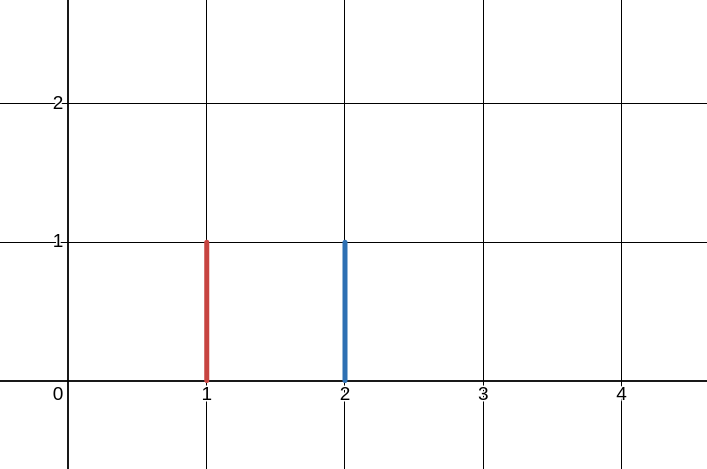
Diagram of PMFs, red for pY(x) and blue for pX(x).
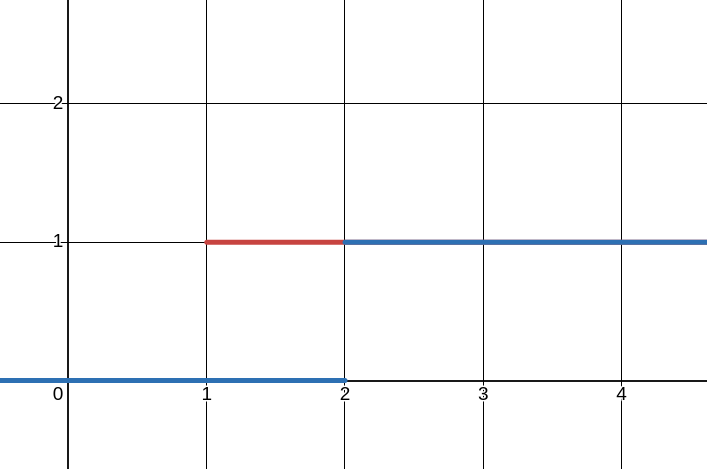
Diagram of CDFs, red for FY(x) and blue for FX(x).
(b)
P(X=x)≤P(Y=x)⟹∑P(X=x)≤∑P(Y=x)
Since limx→∞FX(x)=limx→∞FY(x)=1 therefore,
∑P(X=x)=∑P(Y=x)=1
Thus,
P(X=x)≤P(Y=x)⟹1≤1
But, since P(X=x0)<P(Y=x0) for some x0 (strict inequality), we would need:
∑P(X=x)<∑P(Y=x)
Which gives 1<1, a contradiction, therefore it’s impossible to have such r.v.s.
Question 13
By LOTP,
- P(X=a)=∑zP(X=a∣Z=z)P(Z=z)
- P(Y=a)=∑zP(Y=a∣Z=z)P(Z=z)
Since we know P(X=a∣Z=z)=P(Y=a∣Z=z), for all a and z, therefore,
z∑P(X=a∣Z=z)P(Z=z)=z∑P(Y=a∣Z=z)P(Z=z)
Using the equations above,
P(X=a)=P(Y=a)
Question 14
(a)
- P(X≥1)=1−P(X=0)=1−e−λ
- P(X≥2)=1−P(X=0)−P(X=1)=1−e−λ(1+λ)
(b)
pX(k)=P(X=k∣X≥1)=P(X≥1)P(X=k∩X≥1)=1−e−λe−λλk/k! for k≥1
Question 15
FX(x)=⎩⎨⎧x<11≤x≤nx>n0n⌊x⌋1
Question 16
P(X=x∣X∈B)=P(X∈B)P(X=x∩X∈B)=∣C∣∣B∣∣C∣1=∣B∣1⟹(X∣X∈B)∼Dunif(B)