Variables
Definition
Variable
A variable is sometimes thought of as a mathematical “John Doe” because you can use it as a placeholder when you want to talk about something but either (1) you imagine that it has one or more values but you don’t know what they are, or (2) you want whatever you say about it to be equally true for all elements in a given set, and so you don’t want to be restricted to considering only a particular, concrete value for it.
Definition
Three of the most important kinds of sentences in mathematics are universal statements, conditional statements, and existential statements:
- A universal statement says that a certain property is true for all elements in a set. (For example: All positive numbers are greater than zero.)
- A conditional statement says that if one thing is true then some other thing also has to be true. (For example: If 378 is divisible by 18, then 378 is divisible by 6.)
- Given a property that may or may not be true, an existential statement says that there is at least one thing for which the property is true. (For example: There is a prime number that is even.)
The Language of Sets
Notation
Set-roster Notation
If is a set, the notation means that is an element of . The notation means that is not an element of . A set may be specified using the set-roster notation by writing all of its elements between braces. For example, denotes the set whose elements are , , and . A variation of the notation is sometimes used to describe a very large set, as when we write to refer to the set of all integers from 1 to 100. A similar notation can also describe an infinite set, as when we write to refer to the set of all positive integers. (The symbol is called an ellipsis and is read “and so forth.”)
Definition
Axiom of Extension
The axiom of extension says that a set is completely determined by what its elements are—not the order in which they might be listed or the fact that some elements might be listed more than once.
Notation
- : the set of all real numbers
- : the set of all integers
- : the set of all rational numbers, or quotients of integers
Notation
Set-Builder Notation
Let denote a set and let be a property that elements of may or may not satisfy. We may define a new set to be the set of all elements in such that is true. We denote this set as follows:
Definition
Subsets
If and are sets, then is called a subset of , written , if, and only if, every element of is also an element of .
The phrases is contained in and contains are alternative ways of saying that is a subset of .
Definition
Proper subset
Let and be sets. is a proper subset of if, and only if, every element of is in but there is at least one element of that is not in .
Notation
Ordered Pair
Given elements and , the symbol denotes the ordered pair consisting of and together with the specification that is the first element of the pair and is the second element. Two ordered pairs and are equal if, and only if, and . Symbolically:
Definition
Ordered n-tuple
Let be a positive integer and let be (not necessarily distinct) elements. The ordered n-tuple, , consists of together with the ordering: first , then , and so forth up to . An ordered 2-tuple is called an ordered pair, and an ordered 3-tuple is called an ordered triple. Two ordered n-tuples and are equal if, and only if, , , , and . Symbolically:
Definition
Cartesian Product
Givens sets the Cartesian product of denoted,
is the set of all ordered n-tuples where . Symbolically:
In particular,
is the Cartesian product of and .
Definition
String
Let be a positive integer. Given a finite set , a string of length over is an ordered n-tuple of elements of written without parentheses or commas. The elements of are called the characters of the string. The null string over is defined to be the “string” with no characters. It is often denoted and is said to have length 0. If , then a string over is called a bit string.
The Language of relations and functions
Definition
Let and be sets. A relation from to is a subset of . Given an ordered pair in , is related to by , written , if, and only if, is in . The set is called the domain of and the set is called its co-domain. The notation for a relation may be written symbolically as follows:
The notation means that is not related to by :
Notation
Arrow Diagram of a Relation
Suppose is a relation from a set to a set . The arrow diagram for is obtained as follows:
- Represent the elements of as points in one region and the elements of as points in another region.
- For each in and in , draw an arrow from to if, and only if, is related to by . Symbolically:
Definition
Functions
A function from a set to a set is a relation with domain and co-domain that satisfies the following two properties:
- For every element in , there is an element in such that .
- For all elements in and and in ,
Notation
If and are sets and is a function from to , then given any element in , the unique element in that is related to by is denoted , which is read “ of .”
Note
If and are functions from a set to a set , then
It follows that: equals , written , if, and only if, for all in .
The Language of Graphs
Definition
Graph
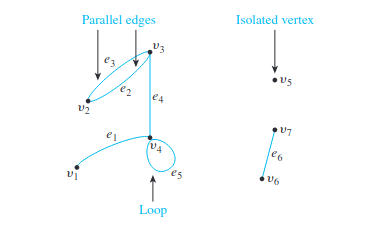
A graph consists of two finite sets: a nonempty set of vertices and a set of edges, where each edge is associated with a set consisting of either one or two vertices called its endpoints. The correspondence from edges to endpoints is called the edge-endpoint function. An edge with just one endpoint is called a loop, and two or more distinct edges with the same set of endpoints are said to be parallel. An edge is said to connect its endpoints; two vertices that are connected by an edge are called adjacent; and a vertex that is an endpoint of a loop is said to be adjacent to itself. An edge is said to be incident on each of its endpoints, and two edges incident on the same endpoint are called adjacent. A vertex on which no edges are incident is called isolated.
Notation
Graphs have pictorial representations in which the vertices are represented by dots and the edges by line segments. A given pictorial representation uniquely determines a graph.
Note
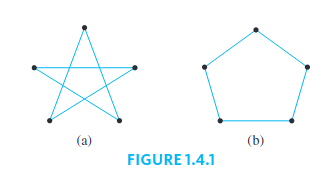
Although a given pictorial representation uniquely determines a graph, a given graph may have more than one pictorial representation. Such things as the lengths or curvatures of the edges and the relative position of the vertices on the page may vary from one pictorial representation to another.
Definition
Directed Graph
A directed graph, or digraph, consists of two finite sets: a nonempty set of vertices and a set of directed edges, where each is associated with an ordered pair of vertices called its endpoints. If edge is associated with the pair of vertices, then is said to be the (directed) edge from to .
Definition
Degree of a Vertex
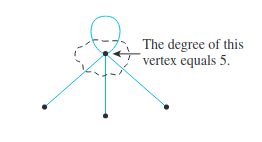
Let be a graph and a vertex of . The degree of , denoted , equals the number of edges that are incident on , with an edge that is a loop counted twice.